

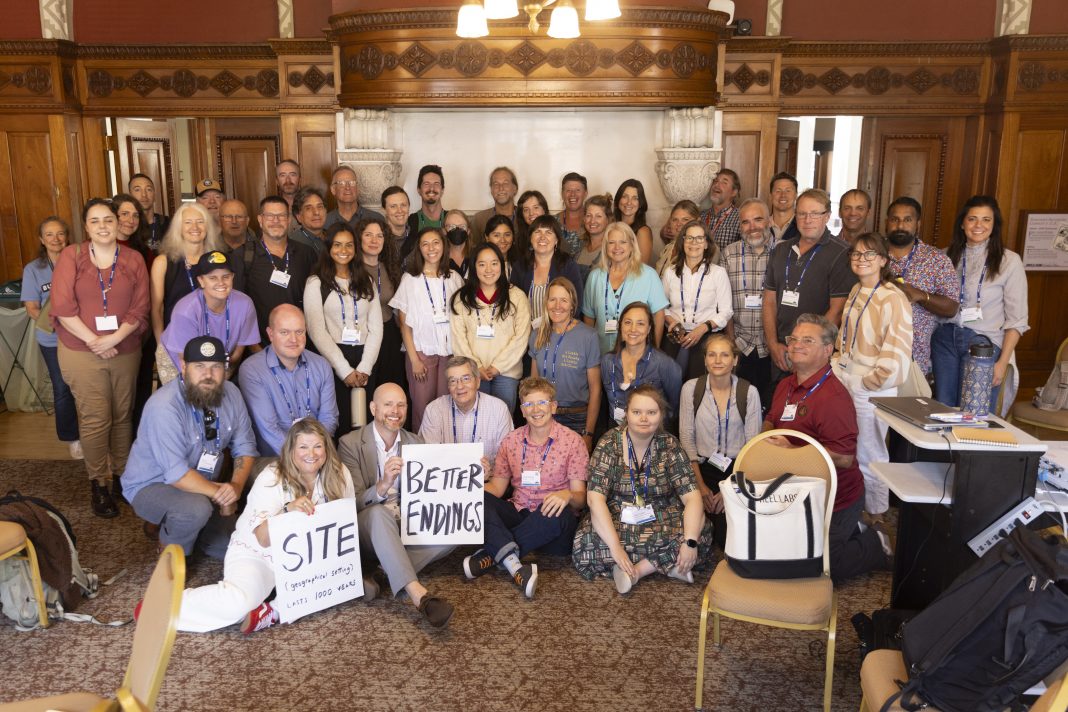

At the Build Reuse conference in Saint Paul, Minnesota, a group of architects, designers, facility managers, deconstruction experts, and sustainability advocates gathered to explore a big question: How do we give buildings better endings?
From that high-energy, donut-fueled session came Better Endings, the newest Circular Workplace Field Guide from Green Standards — a collection of bold, practical ideas for how to design, measure, and market a truly reusable built environment.
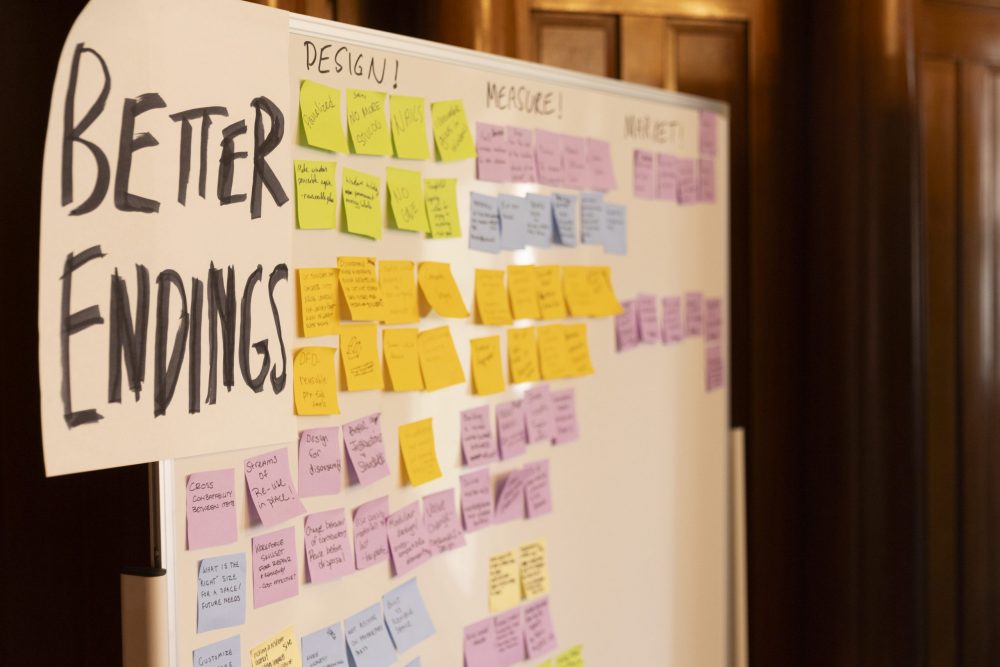



The workshop was led by Benjamin Errett and Heidi Frasure of Green Standards and Celeste McMickle of the U.S. Green Building Council. Together, they guided participants through hands-on exercises and spirited discussion built around Stewart Brand’s “Shearing Layers” model from How Buildings Learn. Brand’s framework — Site, Structure, Skin, Services, Space Plan, and Stuff— captures how buildings change over time. Some layers endure for centuries; others shift with every renovation or occupant. The group’s challenge was to apply that model to the modern workplace — to design spaces that evolve gracefully, reuse intelligently, and never truly “end.”
To design better endings, we started with the knowledge that every ending is planned, intentionally or not, in the beginning. Inspired by Lego, we call for materials and systems that “snap apart and back together,” encouraging reversible connections and modular design. “Screws over glues” becomes a mantra — flexible walls, salvageable cabinets, and adaptable layouts that allow buildings to keep learning and changing instead of being demolished.
To measure better endings, we think about the metrics that truly matter. It challenges professionals to quantify what reuse is worth — tracking salvage value, resale revenue, and deconstruction labor alongside community impact. How much of each project came from, or returned to, the local area? What’s the baseline reuse rate, and how can we boost it next time? Measurement turns ideals into data, and data into action.
To market better endings, we look at the ideas that cut through jargon to truly resonate. We reframe reuse as both storytelling and service: every scratch on a reused chair becomes a “beauty mark,” every item a narrative of continuity. The guide urges teams to make reuse irresistible — “smash that easy button” — by adding value through white-glove services, warranties, and narratives that celebrate legacy over novelty.


Throughout the session, participants reimagined language. “Disposal” became “offboarding.” “Demolished” turned to “polished.” “Old” became “heritage.” By shifting words, we shift mindset — from wasteful endings to circular beginnings.
Better Endings is written for everyone shaping the built environment: interior designers, architects, facility managers, developers, sustainability leads, and anyone who believes buildings can be as adaptable as the people who use them. It’s a resource for those designing workplaces that last by changing — buildings that learn, and teach.
Green Standards leads this mission globally, helping organizations decommission offices sustainably by keeping assets in use and out of landfill. Since 2009, we’ve partnered with 40% of the Fortune 100, donating more than $50 million worth of furniture, fixtures, and equipment to schools and nonprofits in over 40 countries.
Want to Hear More From Green Standards? Check Out Loop ‘Em In: How to Sell Circularity to Skeptical Stakeholders.

Want to Hear More from Heidi Frasure? Check Her Talk Out at 2025 CoreNet!
Learn more and join the movement toward a zero-waste workplace at circularworkplace.com
See What WDM’s Cynthia Milota Learned from the Build Reuse Conference.
This article was created in partnership with Green Standards. Images courtesy of Green Standards.