

Why smart office design that builds relationships is the key to attracting talent, driving performance and sparking innovation.
It’s Monday morning, and Sarah, a software engineer, is deciding whether to work from home or head to the office. The deciding factor isn’t the ergonomic chairs or free coffee —it’s knowing her team of four developers gathers at 10 AM in their corner collaboration pod for “code and coffee.” This 15-minute ritual of sharing weekend stories while reviewing code has become the week’s highlight. What Sarah doesn’t realize is that her brain releases endorphins during these synchronized social moments, strengthening bonds that make her team more productive. The magic isn’t just team chemistry — it’s how the space was designed with sight lines for natural connection, acoustic zones for focused conversation and flexible seating for their preferred circle formation.
This intersection of human psychology, group dynamics and workspace design is revolutionizing how organizations attract talent and drive performance.
“Our research shows that social-spatial strategies — designing spaces that encourage connection and give people different ways to interact — are becoming more valuable and important in the workplace for both employees and employers,” says Ruth Hynes, Global Research Lead of Project Development Services for JLL.
Measuring what Matters
Most organizations measure office performance with occupancy rates and space utilization data — and those metrics remain important. But the real value of bringing people together goes much deeper than just getting employees to show up. It’s about the relationships that help teams make better decisions, share information faster and come up with breakthrough ideas.
These connections become the basis for how knowledge spreads, problems get solved and company culture takes shape.
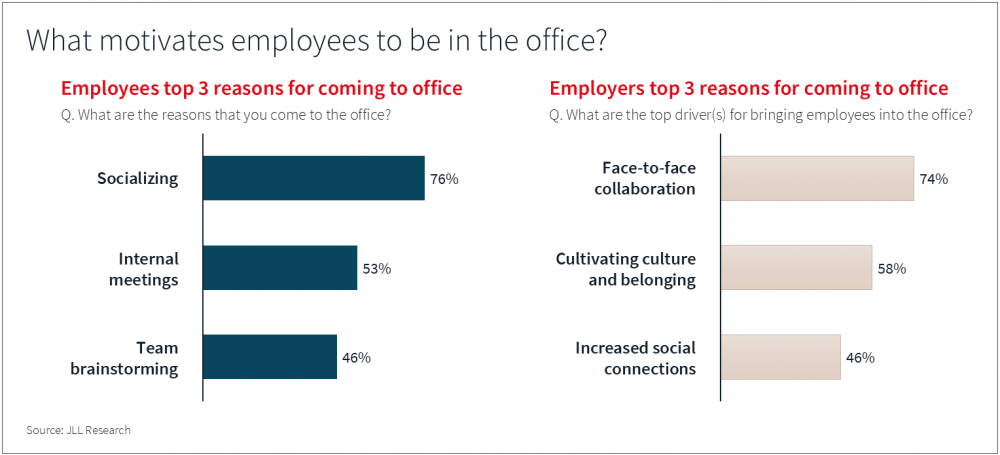
JLL research backs up this assertion in our Future of Work survey. Among employees, socializing ranks as the number one reason for coming to the office, alongside planned collaboration and brainstorming. For employers, face-to-face collaboration tops the list for bringing employees into the workplace, followed by cultivating culture and belonging, and increased social connections.
These results highlight a health component that is frequently overlooked, according to the World Health Organization: “social health” is a critical part of our well-being, referring to the quantity and quality of relationships needed. When all three parts of a person’s health — physical, mental and social — are reflected in the workplace, we create the conditions needed for top performance.
While social health might initially seem like it doesn’t depend on physical space, designers play a foundational role in promoting relationship-building at the office by creating spaces that foster spontaneous and planned connections.
“How spaces connect to each other, their size, how many people use them, what you can see from where you sit, what activities happen there — all of this affects how well people perform,” says Adrian Davidson, Global Design Advisory Lab Lead for JLL. “As designers, we need as much input and insight as possible to create spaces that really work for people; spaces that are both creative and practical.”
Now science is making the case for relating social-spatial strategy to workforce output. Research from Thompson Harrison (TH) shows the most effective workspaces use social-spatial strategies to advance the small group dynamics that improve team performance and build bonds between colleagues — and we agree this evolution in workplace design is a trend to follow in 2026.
The Science Behind Social-Spatial Design
Let’s dig into the neuroscience nuances that impact our workplace experience. Research reveals humans naturally organize relationships into layers, with our closest bonds limited to about five people, and meaningful concurrent connections capping at 150.
“There are very specific sizes for groups that affect their functionality, and it depends on how well people know each other and how much time they’ve spent together,” explains Robin Dunbar, Professor of Evolutionary Psychology at University of Oxford and co-author of The Social Brain. “We devote about 40% of our social time to five people, 60% to 15 (which includes the initial five).”
This group dynamic easily translates from personal to professional. Developing alliances at work can mean the difference between a functioning team and an underachieving one. Studies show that oversized teams lose trust and communication breaks down, leading to inefficiencies and frustration.
“We are at our best in small groups where we can take advantage of collective intelligence, safety, mutual obligation and discretionary effort,” explains Tracey Camilleri, co-founder of TH and co-author of The Social Brain. “Social strategies should inform workplace design. We need to shift from thinking about square feet to thinking about how we inhabit space together productively. To achieve the best of both virtual and in-person collaboration, we must work with, not against, the grain of our inherited human behavior.”
That all sounds logical, but where to start? How do we design socially healthy environments that supercharge productivity? Working with TH and JLL Design experts, we’ve launched a new social-spatial methodology to design workplaces where people choose to be and where they thrive.
Thriving with Social-Spatial Workplace Design
The social-spatial trend is evolving office design from emphasizing spaces that only support individual performance to those that empower team and collective performance. Our methodology incorporates social health elements that boost performance, innovation and impact in the workplace — connection, belonging, value, purpose, culture and learning — as we create different space types and layouts.
“Start every design process by figuring out what social and functional outcomes you want to achieve,” advises Stephen Jay, Global Design Advisory Retail and Branding Lead for JLL. “Designers need to think holistically about varying rhythms between people and anticipate conditions where and how people want to engage with each other. Get the actual users involved in the process — spaces need to function for individuals, teams and the whole organization.”
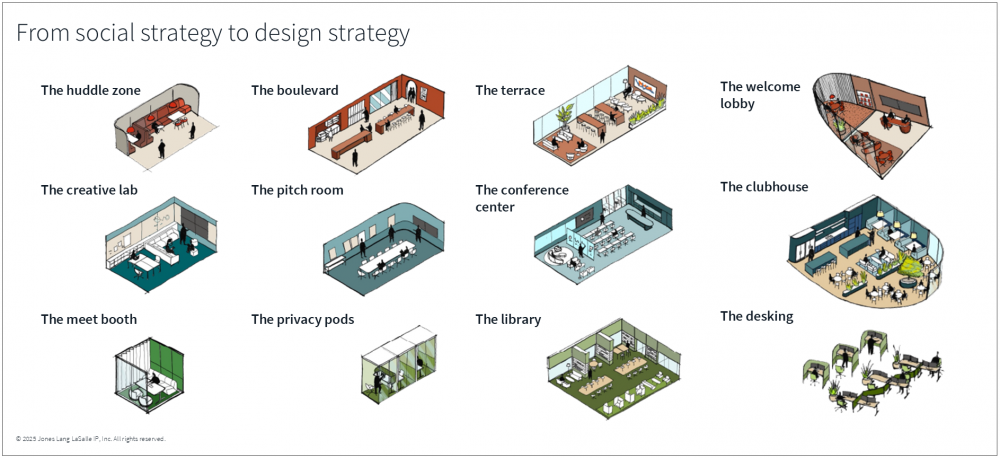
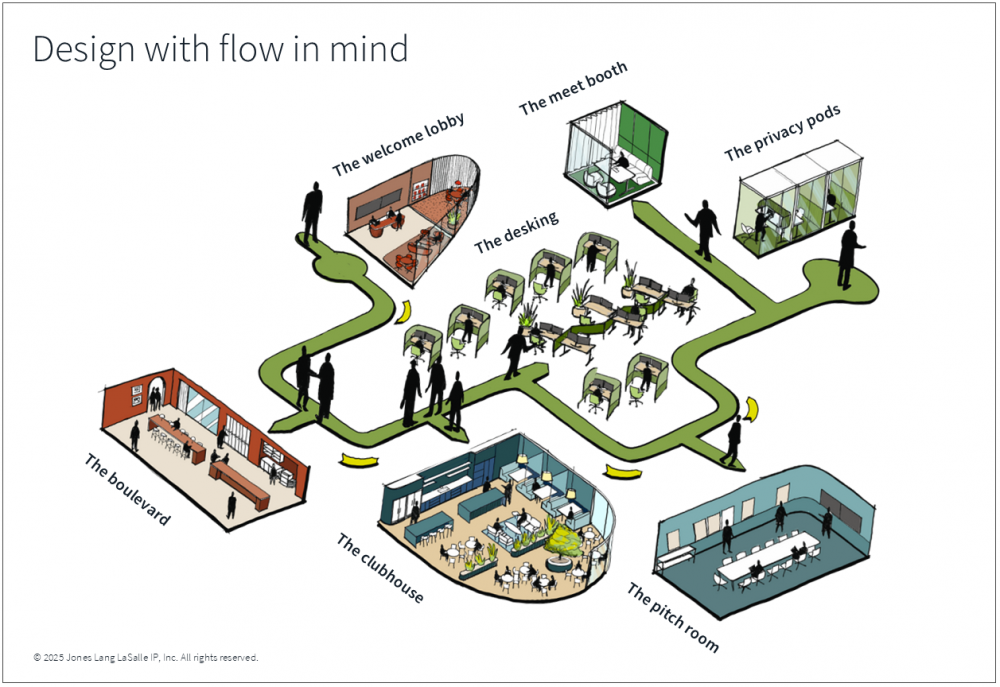
Consider your experience in an ideal workplace setting on a typical day. As you enter the welcome lobby, a smile crosses your face as your favorite concierge greets you. A sense of belonging and connection reenergizes you after your commute, and you’re ready to start the day.
Later, you may feel a strong sense of purpose and value when you have heads-down time in a privacy pod or at your desk, working quietly alongside teammates. Then, seeking connection and belonging, you book a huddle zone or meet booth to collaborate with a teammate or two. For larger team meetings or training, you might head to a creative lab or conference center.
At another point in the day, you might head to clubhouse-type flex space to gather for shared meal, or take your weekly coffee break on the terrace to reconnect with an associate. Maybe you catch up with a coworker at the end of the day on your walk from your lockers in a boulevard space, lingering to continue the spontaneous conversation. These spaces host rituals that contribute to connection, cultural and learning elements.
Whether you’re using the welcome lobby, the boulevard, huddle zones, clubhouses, creative labs, conference centers, pitch rooms, privacy pods, meet booths, libraries or desking areas, each space purposely serves different group sizes and interaction types.
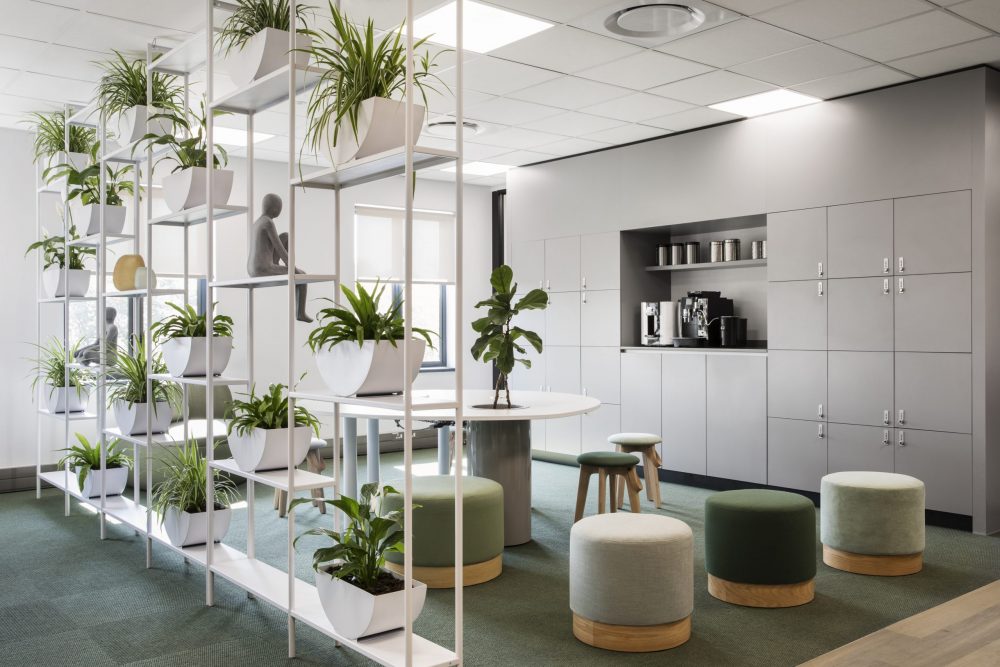
“When starting a project, we need be strategic and intentional about where people will connect socially and why,” says Davidson. “Some spaces have multiple uses, like a café that supports rituals and special events. But we sometimes forget about the in-between spaces — entrances, lobbies, boulevards — where people naturally bump into each other. These transition areas can be designed intentionally to spur human connection, whether it’s a quick hello or a deeper conversation.”
Going with the Flow
Workplace design should reflect natural human behavior. This approach requires keen observation of how people move through and use spaces. Understanding the desired workplace user experience is key to creating an effective, successful workspace.
“Workplace designers need to understand what people need physically, emotionally and digitally,” says Jay. “When we study how work actually flows, we ask: ‘How can we make this better for people? How can we make it simpler, easier, more memorable? How can we arrange spaces so people move naturally through them have chances to connect with each other?’
This includes thinking about how people’s energy changes throughout the day and designing spaces that work with these natural shifts.
“Different work requires different energy levels, and different teams naturally operate at varying intensities,” says Susan Chang, Senior Vice President of Workplace Design Advisory for JLL.
“We can predict when people will be hungry, tired or need to collaborate, and create spaces that support these different moods and needs as the day unfolds,” adds Jay.
Time to Thrive: Social-Spatial Concepts Will Shape Workplace Design in 2026
For workplace designers, this social-spatial research means flipping the design process. Instead of starting with how much space you need or what functions to include, start with how you want people to connect and collaborate.
“Even as workplaces change, the basics of how humans think and behave stay the same,” says Jay. “Our job as designers is to create spaces that work with these realities, supporting people’s social needs that help them get work done. When we do that right, we create places where people truly want to be — spaces they feel proud to call their own.”
When we design spaces that honor natural social behaviors — from close-knit team collaboration to spontaneous encounters from our wider social circle — we create more than efficient workplaces. We create environments where showing up energizes both individuals and teams, transforming in-office attendance from obligation to opportunity. The most successful workplaces in 2026 won’t just house work — they’ll nurture the human connections that make exceptional work possible.
Want to learn more about the interplay between neuroscience, group dynamics and workplace design? Watch a webinar featuring experts from JLL and TH: Supercharge Team Productivity.
Special Thanks to Our 2026 Trends & Predictions Supporter:

Let’s design spaces that resonate and inspire great work. Explore the Resonant Spaces collection.