



We’re entering a decade where AI can think for days, robots become teammates, quantum models predict unseen futures, and buildings act like intelligent systems. But the real transformation isn’t the tech—it’s how human judgment, trust, and design choices shape this new era of work.
When AI thinks longer, output gets better. So, what happens when systems can think for hours or days?
Take AI-assisted code modernization. Blitzy’s AI refactored a 20-year-old, 150,000-line MATLAB codebase into Python in one week, a process that once took months. The AI handled 80% of the work; engineers completed the final 20%.
Most people fixate on the 80%. The real story is the 20%. This is where engineers made architectural decisions, resolved edge cases the AI couldn’t anticipate, and ensured the code actually solved business problems. That’s where human judgment multiplies value. AI’s efficiency doesn’t replace us; it amplifies our capabilities, freeing us to do work of far greater consequence.
That’s the massive unlock, yet it immediately raises uncomfortable questions: If AI can do 80%, what happens to entry-level roles? To training pathways? To how we design teams?
This means we’re in a period of reinvention: structural, cultural, and economic. Every company is rethinking how intelligence, people, and technology interact. Let me reassure you: It won’t happen overnight, but it will happen. Within the next decade, we’ll experience a century’s worth of innovation, driven by Agentic AI, robotics, quantum computing, and more.
Five radical shifts define this moment. Together, they reveal a meta pattern: intelligence is becoming infrastructure.
Here’s what matters now.
-
Welcome to the Agentic Mesh. You’re Now an “Agent Boss.”
We are the last generation to manage a human-only workforce. In a human + AI world, the key question isn’t how do I get this done? but what human-AI combination yields the best outcome? You’re not only managing people but also orchestrating AI agents alongside them.
Microsoft research shows 42% of leaders expect their teams to be coordinating AI agents within five years.
Reality check:
- Reliability gaps: Agents hallucinate and make overconfident errors. Enterprises require human review for sensitive tasks adding oversight costs they didn’t anticipate.
- Integration pain: Legacy systems weren’t built for AI. Integrating securely can take months of process reengineering and change management.
- The handoff problem: Escalate too often and humans become the bottleneck; too little and AI acts beyond its competence.
Skills that now matter the most: prompt + context engineering (structuring inputs so AI agents perform accurately), AI workflow design, evaluation frameworks to catch mistakes.
Start here: Pick one low-stakes workflow. Add AI with human review. Measure speed, quality, and failure modes before scaling.
Implication: Work is shifting from doing the work to designing how work gets done. That design is harder than most leaders expect.
As we coordinate AI agents, how we interact with them is evolving too.
-
The Screen Era Is Ending
For 30+ years, we’ve worked behind glass rectangles. That’s starting to shift.
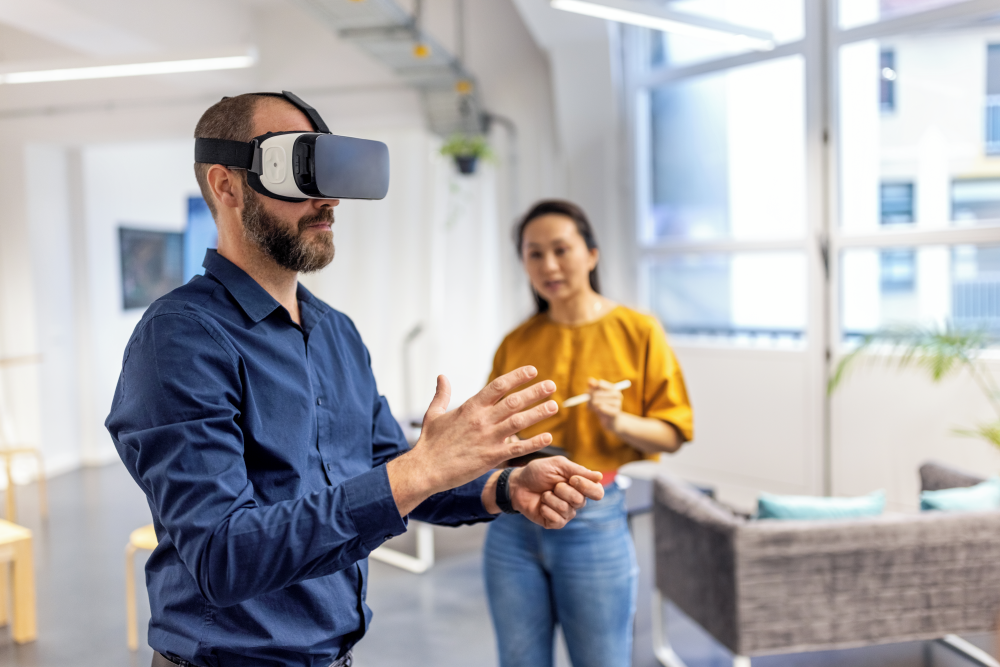
If you haven’t used voice to interact with AI, try it. It is an accelerant. Then think about what happens as this integrates with AR glasses. Neither is science fiction. As these ideas combine, you can see why we may be looking down at our glass screens LESS and looking through glass screens MORE.
Early signs are emerging. Consider this: Meta’s EMG wristbands read neural signals. Apple’s latest AirPods translate speech in real time. Amazon is piloting AR glasses for delivery staff. The next era is ambient computing: voice, gesture, and thought-based control will compliment screens. This redefines interface design across industries, from logistics to health care.
Reality check:
- Privacy + safety: Always-on sensors, cameras, and neural inputs create new risks. Enterprises will need strict governance and consent/trust frameworks before scale.
- Accessibility: Voice and gesture interfaces exclude some workers, forcing companies to maintain multimodal options.
- Cultural friction: Professionals resist being “always observed.”
Five-year reality: Hybrid interfaces dominate. AR supports fieldwork, voice handles simple queries, but screens remain essential for dense information tasks.
Implication: The most valuable interfaces will be invisible and trusted. Build privacy, safety, and accessibility into design from day one.
Beyond changing interfaces, AI is entering physical space.
-
Robots Become Colleagues
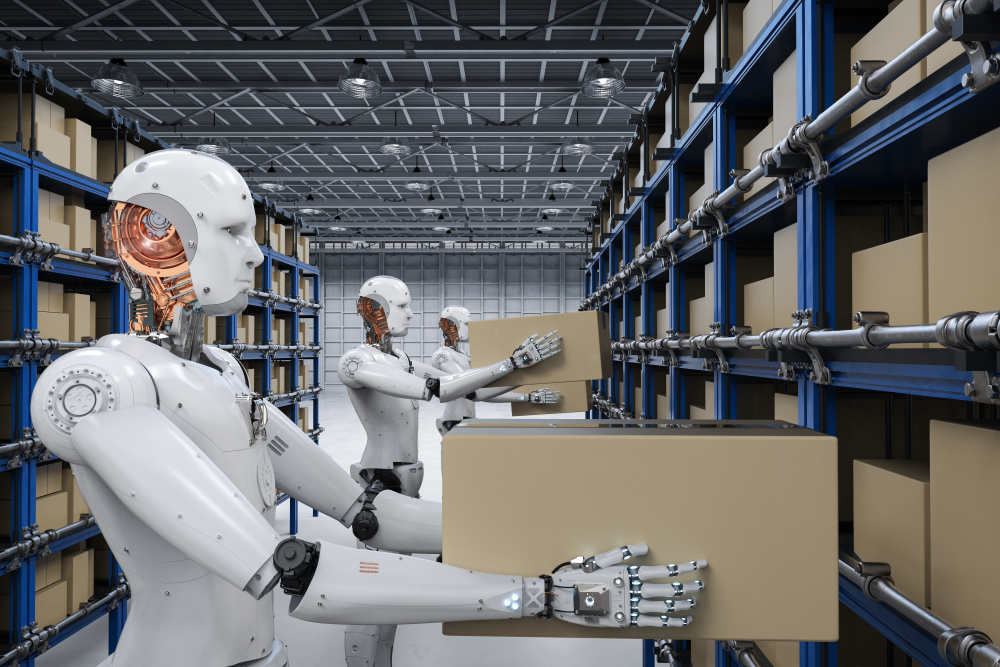
There may be ten billion humanoid robots by 2040, and according to JLL Research, owning a humanoid robot could become a reality as soon as 2028 for many organizations and households.
Amazon already runs over one million robots. The $16,000 Unitree G1 and Figure 02 (5’6”, 70 kg) are early examples of robots working beside humans. BMW is testing Figure robot in factories, as Amazon is testing Agility robots in warehouses. As physical AI matures, robotics moves from experimental pilots toward operational integration.
Reality check:
- Dexterity gap: Robots still struggle with tasks a child can do such as folding a shirt, picking up a pen.
- Economics: Maintenance, downtime, and human supervision make true ROI uneven across industries.
- Workforce transition: Companies will need to upskill and retrained hundreds of thousands of workers as they scale robotics.
What works: Start with collaborative robots that augment humans. Focus on repetitive or hazardous work. Plan for workforce training prior to implementation.
Implication: Hybrid work will soon mean working with and alongside robots. Progress is real, but slower and costlier than headlines suggest.
While robots perform physical work, new paradigms are emerging that aim to solve problems classical computers cannot solve.
-
Quantum Shows Promise
While AI dominated our collective attention, quantum computing has shown meaningful progress albeit in controlled environments.
Google’s Willow chip (2024) outperformed classical supercomputers on synthetic benchmarks. Amazon’s Ocelot, Microsoft’s Majorana 1, IBM’s Nighthawk and Loon, showcase each tech giant’s unique approach to advancing the field of quantum computation.
Early results show potential: HSBC reported quantum advantages for optimization; JPMorgan and Deloitte are exploring financial modeling and fraud detection.
Reality check:
- Synthetic advantage: Many “quantum wins” are benchmark-only, not business problems.
- Error rates: Results still require classical verification.
- Narrow value: Most real gains appear narrow areas such as molecular simulation and cryptography.
Timeline: For most companies, quantum remains a 5 to 10-year horizon.
Exceptions: Pharma, logistics, and firms tackling massive optimization problems.
Action now: Partner with cloud providers for experimentation. Prioritize post-quantum cryptography as defense matters more today than offense.
Game-changer: Quantum computing allows us to model futures that haven’t happened yet and this will be tomorrow’s advantage.
These technologies converge most visibly where the bits meet the atoms.
-
The Built Environment Gets Truly Intelligent
Entire buildings are becoming adaptive systems. Real estate is a proving ground for applied AI where digital intelligence intersects with physical infrastructure at scale.
Platforms like, JLL’s Falcon with tools like JLL GPTTM and Azara enable professionals to query real estate data conversationally and unify connected and non-connected assets. Real world results show faster insight generation, millions in cost avoidance and energy optimization for client partners.
Smart buildings already reduce energy use 10 to 25% and extend asset life through predictive maintenance.
Reality check:
- Value drivers: Narrow use cases such as energy and maintenance optimization pay off fastest.
- Integration tax: Legacy systems from multiple vendors make data unification costly, often exceeding software costs.
- Contracting methods: Require procurement strategies that ground contracts in today’s realities. You do not want to be stuck with a pre-AI era contract in a world where AI agents can accelerate outcomes.
Start here: Implement AI optimization where ROI is clear, but rework procurement and operating models simultaneously to sustain value.
Implication: The built environment must evolve from passive to intelligent infrastructure. For success your vendors, contracts and operating models MUST keep pace.
The Meta-Pattern: Intelligence as Infrastructure
Intelligence is shifting from scarce resource to core infrastructure: from AI agents that think for days to quantum systems that simulate complex futures.
Infrastructure follows hard economics:
- Upfront costs > early benefits. Like electricity’s rollout, AI infrastructure build-out is seeing substantive investments. Benefit realization will follow.
- Reliability is absolute. Privacy breaches, lack of transparency, errors, and downtime erode revenue and trust.
- Integration is the hidden tax. Connecting new intelligence to legacy systems often costs multiples of the tech itself.
- Complementary investments are mandatory. AI needs quality data, governance, and trained workers just as electricity needed wiring and electricians.
- Transition costs are real. Workforce retraining takes years. Some workers exit; others stay but report higher stress. Responsible leaders invest early, often spending multiple dollars on training for every dollar on tech.
The Real Choice
This moment calls for leadership rooted in humanity: asking how does this make work more meaningful? before how does this make work more efficient?
The real work is making intelligence meaningful, amplifying human potential, not just efficiency. The choice isn’t adoption vs. resistance; both deploy the same tools. The real divide is in our decision-making impetus:
- FOMO-driven: Chases hype, ignores displacement, and learns too late that infrastructure without trust is just expensive equipment.
- Bold, pragmatic, human-centric: Acknowledges trade-offs, invests in transitions, designs for human flourishing, and measures more than quarterly returns.
The future of work won’t happen to us, it’s something we design together. Agents, ambient interfaces, robotics, quantum, intelligent buildings – these aren’t five separate bets. They’re one fundamental shift: intelligence becoming infrastructure. Success requires orchestrating all of it with human judgment at the center.
Leaders who act decisively today will set the foundation for the next decade.
Special Thanks to Our 2026 Trends & Predictions Supporter:

Let’s design spaces that resonate and inspire great work. Explore the Resonant Spaces collection.